

Stop Wasting Time on Busy-ness: How Mission-Driven Leaders Prioritize Impact Over Activity

Picture this: You've just wrapped a twelve-hour day. Your inbox has more unread messages than when you started. You attended six meetings, approved fourteen things, and put out three fires. And yet, when you ask yourself what you actually accomplished today, what moved your organization closer to its mission, you draw a blank.
Welcome to the hamster wheel of busy-ness, where motion gets confused with progress.

For mission-driven leaders, especially those in the nonprofit sector, this isn't just a productivity problem. It's a mission problem. Every hour spent spinning your wheels on low-impact activities is an hour stolen from the people, communities, or causes you're trying to serve. And let's face it: your team is watching. When leadership operates in reactive chaos mode, that energy trickles down fast.
So how do you escape the busy-ness trap and start prioritizing actual impact? It starts with understanding that activity and accomplishment are not the same thing, and building systems that help you tell the difference.
The Busy-ness Epidemic: Why Nonprofits Are Especially Vulnerable
Nonprofits operate in a perfect storm of conditions that breed busy-ness over productivity. Limited resources? Check. Urgent needs everywhere? Double check. Pressure from funders, boards, staff, and beneficiaries pulling you in seventeen directions at once? Triple check with a side of existential dread.
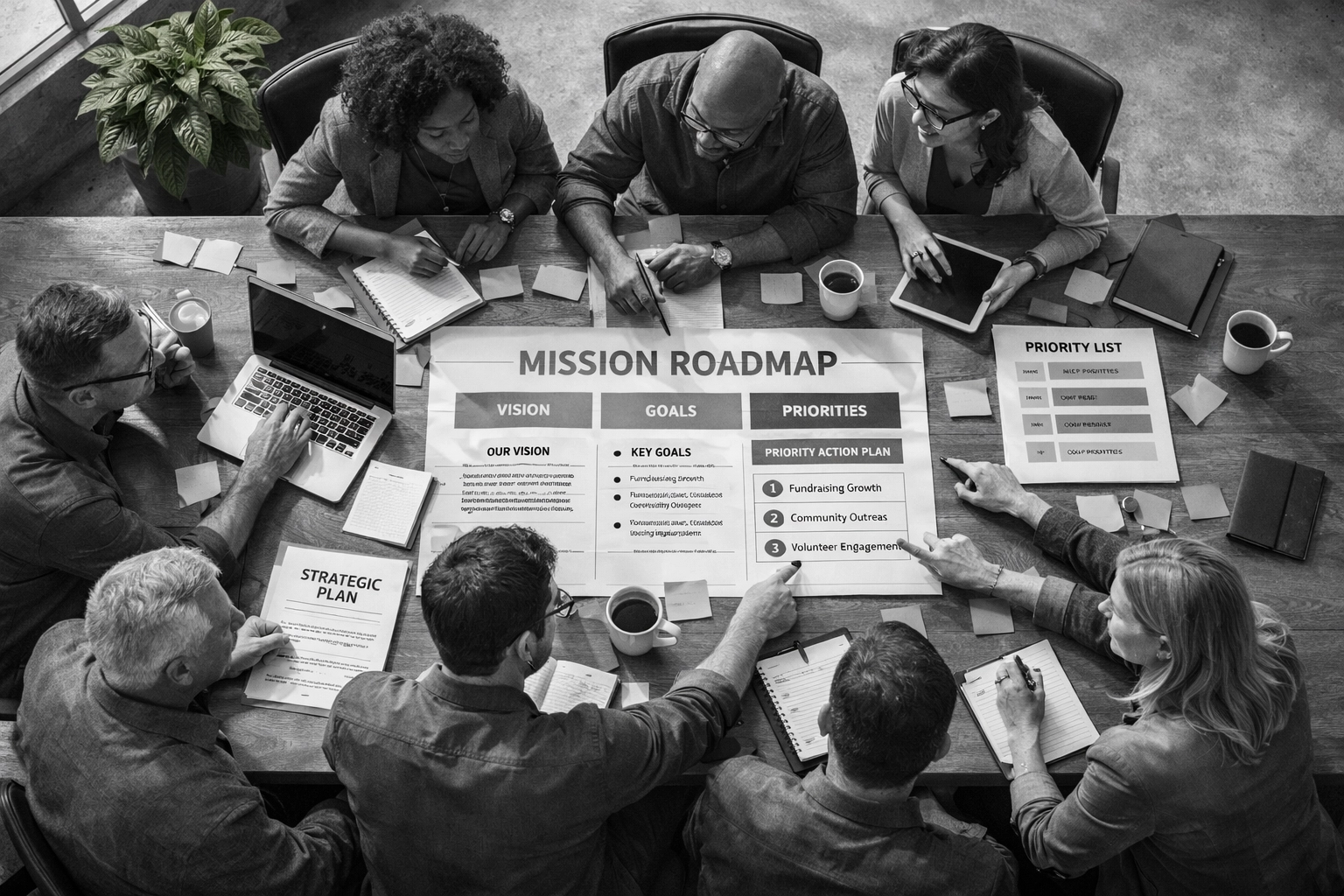
Add in the emotional weight of mission-driven work, where saying "no" can feel like you're failing the very people you set out to help, and you've got a recipe for chronic overwhelm. The result? Leaders who confuse a packed calendar with effectiveness and mistake exhaustion for dedication.
But here's the uncomfortable truth: being busy doesn't make you a hero. It just makes you tired. And burned-out leaders don't change the world, they just survive it.

Purpose as Your North Star (and Your BS Filter)
Mission-driven leaders have a secret weapon that corporate executives often lack: a crystal-clear sense of why they exist. Your mission isn't just a statement on your website, it's a decision-making filter that can save you from drowning in distractions.
Here's how it works: Before saying "yes" to that new partnership, additional report, or "quick" side project, ask one simple question: Does this advance our mission?
Not "Is this a good opportunity?" or "Will this make someone happy?" but genuinely, does this move us closer to our core purpose?
Research backs this up. Leaders who operate from a deep sense of purpose beyond themselves naturally eliminate busywork because they've clarified what actually matters. When your decisions align with a singular mission, you stop chasing every shiny object that crosses your desk. You get selective. Intentional. Strategic.

Actionable Tip: Create a "mission filter" document. List your organization's core objectives, no more than 3-5. Before committing to any new initiative, literally check it against this list. If it doesn't clearly support at least one objective, it's a hard pass.
Metrics That Matter: Defining Success Before You Chase It
You can't prioritize impact if you don't know what impact looks like. And yet, so many nonprofit leaders operate without clearly defined success metrics, or worse, they track metrics that measure activity rather than outcomes.
Let's get real: counting the number of workshops you hosted isn't the same as measuring whether those workshops actually changed behavior. Reporting on "engagement numbers" tells you nothing about whether you're solving the problem you set out to solve.

Mission-driven leaders who successfully prioritize impact do something different: they define milestones and metrics upfront, then use those as guardrails for where they invest time and resources. This prevents the scatter of effort across undefined or competing objectives, and it gives you permission to say "no" to things that don't move those specific needles.
Clear communication matters here too. Your team needs to understand not just what needs to be accomplished, but how success will be measured. When everyone knows the target, you stop wasting energy debating whether something is worth doing and start asking whether it's the best use of limited resources.
Actionable Tip: Pick 3-5 key performance indicators (KPIs) that directly reflect mission impact, not just activity. Share these with your team monthly. When someone proposes a new project, ask: "Which KPI does this move?"
The Liberating Power of "No"
Here's where things get uncomfortable: You cannot do everything, and pretending you can is not noble, it's delusional.

The word "no" is not a moral failing. It's a strategic tool. Every time you say "yes" to something that doesn't align with your mission priorities, you're implicitly saying "no" to something that does. You're just doing it in a way that drains your capacity and sets you up for mediocrity across the board instead of excellence where it counts.
Mission-driven leaders who master the art of "no" aren't cold or uncaring, they're clear. They understand that finite resources (time, money, people, energy) demand tough choices. They'd rather do three things exceptionally well than fifteen things poorly.
This doesn't mean ignoring urgent needs or being inflexible. It means distinguishing between what's urgent and what's important, and having the backbone to prioritize the latter even when it's uncomfortable.
Actionable Tip: Practice the "gracious no." When turning down an opportunity, acknowledge its value while clearly stating why it doesn't fit your current strategic priorities. Example: "I appreciate you thinking of us for this. It's important work, but we're focusing our capacity on X right now to maximize impact."
Long-Term Vision Over Short-Term Noise
One of the biggest traps in mission-driven work is the tyranny of now. There's always a crisis. Always an immediate need. Always someone who needs help today.
And yes, urgency matters. But if you're only ever responding to what's urgent, you'll never build the systems and solutions that create lasting change.

Leaders who prioritize impact over activity think beyond quarterly wins. They ask: What will our community look like in five years if we stay on this path? What infrastructure needs to be built now to create sustainable impact later?
This longer time horizon naturally filters out activities that create busy-ness without lasting results. It also builds organizational resilience, because teams that understand the bigger picture can weather short-term setbacks without losing momentum or morale.
Research shows that mission-driven companies focused on long-term vision experience higher employee engagement and greater resilience during challenges. Why? Because people can see beyond daily tasks to the transformational destination. They understand that today's "no" to distractions is tomorrow's "yes" to breakthrough impact.
The Ripple Effect: How Your Focus Shapes Your Team
Here's the thing nobody tells you about leadership: your relationship with busy-ness shapes your team's culture more than any value statement or org chart.
When you model frantic reactivity, your team learns that looking busy is more important than being effective. When you celebrate activity over outcomes, they'll optimize for the former. But when you demonstrate disciplined focus on mission-aligned priorities, even when it means disappointing people or leaving opportunities on the table, you give them permission to do the same.

The data backs this up: when leaders clearly connect daily work to larger mission, employee engagement skyrockets. Team members feel their efforts matter. They see how their specific contributions fit into the bigger picture. This doesn't just improve morale, it improves retention, creativity, and the quality of execution.
Actionable Tip: In team meetings, explicitly connect current projects to mission outcomes. Instead of reviewing task lists, review impact. Ask: "How is this work advancing our mission?" Make the connection visible and constant.
Putting It Into Practice: Your 30-Day Impact Reset
Ready to stop spinning your wheels and start moving your mission forward? Here's your roadmap:
Week 1: Audit
Track how you spend your time for five days (yes, really)
Categorize activities as "mission-critical," "mission-supporting," or "mission-irrelevant"
Be brutally honest
Week 2: Define
Clarify your 3-5 core mission objectives
Establish clear metrics for each
Share these with your team
Week 3: Eliminate
Identify three "mission-irrelevant" activities you'll stop doing
Draft gracious "no" scripts for common distractions
Block time on your calendar for strategic work (yes, it needs an appointment)
Week 4: Embed
Start every meeting by connecting agenda items to mission priorities
Practice your "no" scripts in real situations
Celebrate wins that move KPIs, not just completed tasks

The Bottom Line
Mission-driven leadership isn't about doing more: it's about doing what matters. Every moment you spend on busy-ness that doesn't serve your mission is a moment stolen from the impact you could be creating.
You didn't get into this work to be busy. You got into it to change lives, solve problems, and make the world a little less broken. That requires focus, discipline, and the courage to disappoint people who want you to be all things to all causes.
The strategic clarity you need to lead through complexity doesn't come from working harder: it comes from working smarter. From choosing impact over activity. From measuring outcomes over outputs. From building organizational health that supports sustainable success, not just frenetic survival.
So here's your challenge: What's one thing you're going to stop doing this week that's keeping you busy but not moving your mission forward?
Your impact: and your sanity( will thank you.)


Comments